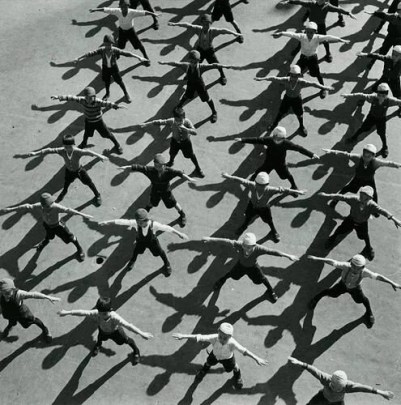
Rebel in the Making: Schoolboys Exercising, with One Eating an Apple (Japan, 1936), Fritz Henle,
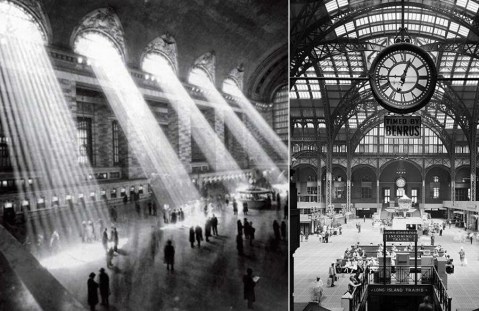
I saw a wonderful show of the photography of Fritz Henle at that Ransom Center at the University of Texas, Austin in 2009. Henle was a master of many different types of photography. There is an excellent catalog of the exhibition published by the University of Texas Press called Fritz Henle In Search of Beauty.
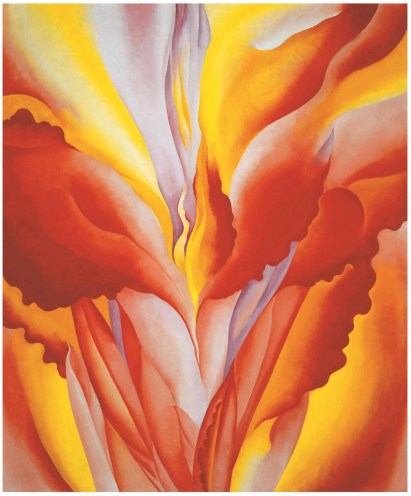
Red Canna by Georgia O’Keeffe, 1923, University of Arizonia Art Museum.
Everyone has many associations with a flower – the idea of flowers. Still-in a way – nobody sees a flower – really – it is so small – we haven’ t the time…So I said to myself – I’ll paint what I see – what the flower looks like to me but I’ll paint it big and they will be surprised into taking time to look at it. – Georgia O’Keeffe,
Georgia O’Keeffe, Viking, 1973.
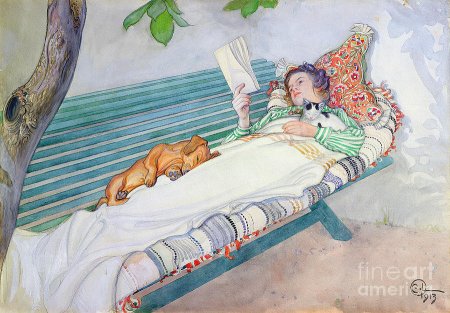
Woman Lying on a Bench by Carl Larsson, 1913, Louvre
I guess it is pretty obvious what I would like to be doing….
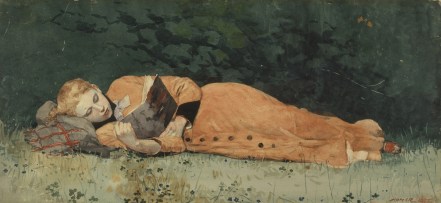
The New Novel by Winslow Homer, 1877, Museum of Fine Art, Springfield MA
This work is a favorite among avid readers and book clubs for obvious reasons. The orange of the dress and the girl’s hair provide a warm contrast against the background dominated by shades of brown and green.
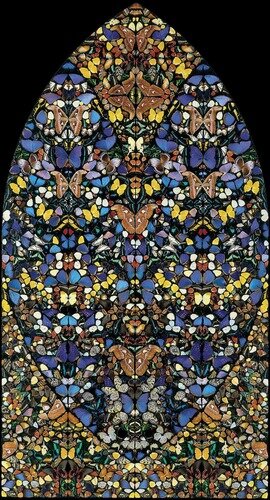
Prosperity – The Holy Place by Damien Hirst, 2006.
This work is created out of butterflies and the perfect symmetry of the insects is mirrored in the perfect symmetry of the work. At first glance it appears to be a stained glass window.
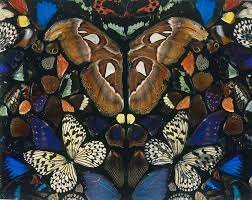
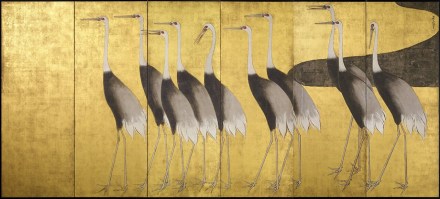
Cranes (detail) by Ogata Korin, Edo Period c. 1700, Freer Gallery of Art, Smithsonian
This is part of a larger work (a screen). The repetition of the from of the group of Cranes gives the work a lighthearted charm.
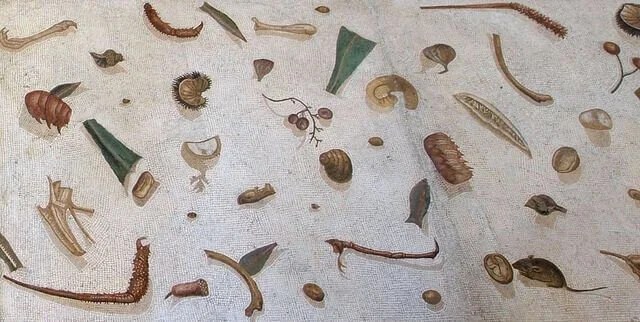
Sosus of Pergamon: The Unswept Floor, Roman Mosaic, 2nd century CE
A Roman mosaic based on an earlier painting. It depicts the remnants of a dinner party scattered all over the floor of a dining room. Do you see the mouse?
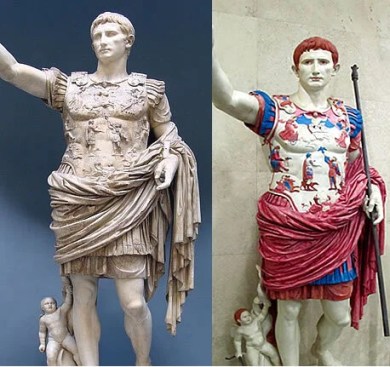
Augustus of Primaporta, Early 1st century CE, reconstructed copy of marble, that is a copy of bronze, with paint.
Sometimes as we look at the art left behind by ancient civilizations we expect that they intended their sculpture to be viewed as the bleached white examples we see today however, that is not the case. The sculpture of the Greeks and the Romans was painted. We know this because remnants of the color survive and in rarer cases, sculpture with the paint still applied survives.
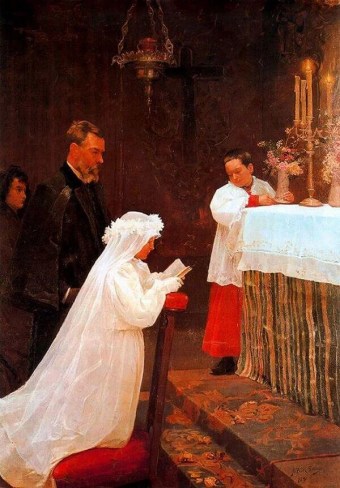
First Communion by Pablo Picasso, 1895-96.
Picasso’s father was a painter who taught his son the skills of an artist at a young age. That allowed him to complete this work at the age of 15.

