Feminist Art or Just Art?

 The Dinner Party

by

Judy Chicago

, 1974-79, 

Brooklyn Museum 

There are two exhibitions at the National Museum for Women in the Arts in Washington DC right now that were organized by the Brooklyn Museum. They are a show featuring the work of artist Judy Chicago, often label as a Feminist, but naturally as labels go, she is that and so much more. The exhibition entitled

Judy Chicago Circa '75

runs now through April 13th.
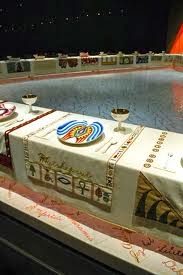
 Detail from

The Dinner Party

by Judy Chicago

 The second exhibition also organized by the Brooklyn Museum is an show called

"Workt by Hand": Hidden Labor and Historical Quilts

.

This exhibition examines quilts, which are historically considered craft and women's handicrafts rather than outlets for creative expression. This show focuses on the limited outlets for creativity for women for hundreds of years and looks at these as a reflection of the artists, as well as utilitarian objects. The exhibition runs through April 27th.

“Workt by Hand”: Hidden Labor and Historical Quilts - See more at: http://www.nmwa.org/exhibitions/%E2%80%9Cworkt-hand%E2%80%9D#sthash.ahnYRAz5.dpuf

“Workt by Hand”: Hidden Labor and Historical Quilts - See more at: http://www.nmwa.org/exhibitions/%E2%80%9Cworkt-hand%E2%80%9D#sthash.ahnYRAz5.dpuf

Elizabeth Welsh of Virginia, Medallion Quilt, ca. 1830; Brooklyn Museum - See more at: http://www.nmwa.org/exhibitions/%E2%80%9Cworkt-hand%E2%80%9D#sthash.ahnYRAz5.dpuf
 Elizabeth Welsh of Virginia, Medallion Quilt, c. 1830, Brooklyn Museum

Elizabeth Welsh of Virginia, Medallion Quilt, ca. 1830; Brooklyn Museum - See more at: http://www.nmwa.org/exhibitions/%E2%80%9Cworkt-hand%E2%80%9D#sthash.ahnYRAz5.dpuf

Inspired by Tradition

 Lightning Snake by Preston Singletary, Traver Gallery

Preston Singletary is an artist who works primarily in glass and draws influence from his native Tlingit background. His work shows influence of native symbols and animals combined with the art glass techniques which flourish among the glass artists of Washington state.


Whale Rider by Preston Singletary and Louis Gardiner


Preston Singletary talks about bringing his native Tlingit culture to his art.


Bought A Book


I have been wanting this book since it came out in 2007 and I just got it this year with a gift certificate. It is beautiful and full of a lot of interesting facts about rings and their meaning throughout history. Plus the pictures! Just what a ring lover, like myself likes to thumb through and admire.


The Fountainheads

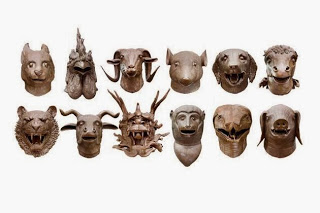
Ai Weiwei, Circle of Zodiac Heads

Currently on display at The Cleveland Museum of Art are Chinese artist Ai Aweiwei's bronze representations of the animals of the Chinese Zodiac. They have been traveling around the world, we saw a glimpse of them in Toronto during the summer and are now installed in the interior court at CMA through January 26, 2014. They are reproductions of the fountain heads from the now destroyed Yuanming Yuan Imperial retreat which were pillaged after the palace was attacked by French and British troops in the 18th century. Ai Weiwei intention is to draw attention to the looting and repatriation of art around the world.

Drawing History

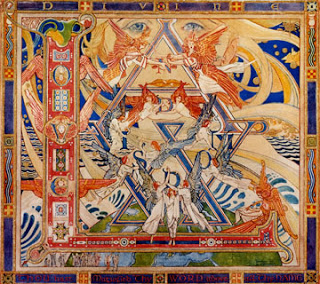
 Divine Law by Violet Oakley, The Pennsylvania Capital Murals, Harrisburg, 1906.

 Violet Oakley was the first woman to receive a major mural commission in the United States when she received the commission for the murals at the Pennsylvania State Capital in 1902.  She studied at the Art Students League and with the great illustrator Howard Pyle. She began her career as an illustrator which served her well in the stories she told with her narrative murals.


Portrait of Violet Oakley by Edith Emerson, Woodmere Art Museum, Philadelphia.

Standing Guard


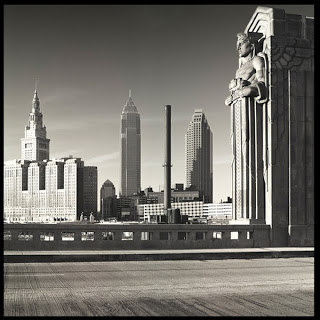
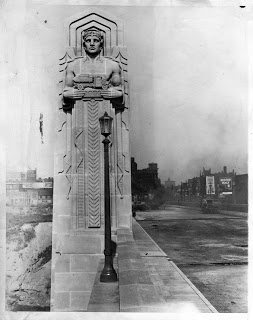
 The large figures on the Hope Memorial Bridge in Cleveland (also known as the Lorain-Carnegie Bridge) were created by sculptor Henry Hering in 1932 and executed by many stone carvers who found much work in Cleveland in the early 20th century. The architects of the bridge were the firm of Walker and Weeks. Hering was primarily a Beaux-Arts style sculptor, having been a student of the famous Augustus Saint-Gaudens, and the architect Frank Walker is credited with the over-all art deco design of the figures. In the 1970's they were almost taken down and the county engineer at that time thought they were hideous, but thank goodness they saved and remain an important part of the city landscape. The bridge was renamed the Hope Memorial Bridge in 1980 after the entertainer Bob Hope donated money for its restoration because his father had worked on it.


Hope Memorial Bridge: Guardians of Traffic holding truck - CSU Digital Humanities

Richness of Color

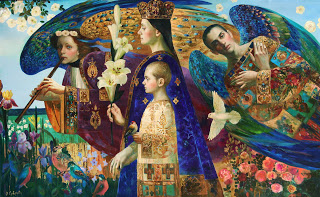
 Universe by Olga Suvorova

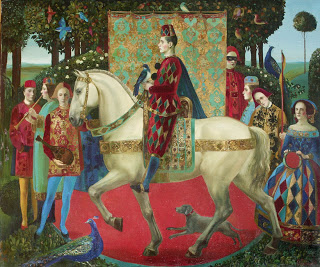
Another of the artists I have found on Pinterest series. Olga Suvorova (b. 1966) is a Russian artist whose beautifully detailed paintings call to mind the rich color and workmanship of the great Northern Renaissance artist Jan van Eyck and the Henry VIII court painter Hans Holbein. Suvorova's detail and imagination, combined with her use of color, create truly breath-taking paintings. 


The Theatre by Olga Suvorova

Art for All


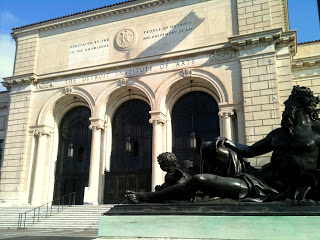
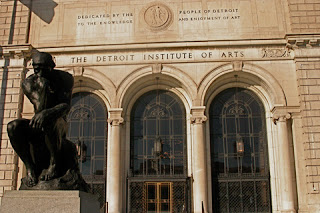
Everyone knows about the financial and societal woes of Detroit. The once grand and prospering city has been in decline for decades now and an emergency manager was appointed in March which gave fiscal control to the state instead of the city. Last week the news came out that all city interests are being examined as possible revenue streams, up to and including, the city owned Detroit Institute of Arts. Now in all probability, the city would not be able to sell off assets given in trust or as gifts to the institution and the idea has already sparked a backlash in the museum community who would take it as a direct assault on museums in general. Even the suggestion of looting the collection really drives home how desperate situation is. The DIA owns some spectacular pieces, a Brueghel any museum would love to own, a beautiful Caravaggio, the painting by Whistler that sparked (pun intended) the legendary Whistler vs. Ruskin case, a sublime Bingham, and of course the Rivera Court, just to name a few. Perhaps all this publicity will remind people the depth and beauty of the collection and how a visit, over the course of the summer, to see it  for themselves would do the DIA and the city good.

Quiet Remembrance


Although considered part of the Harlem Renaissance movement, Motley never lived in Harlem. He was born in New Orleans and moved to Chicago where he studied art the School of the Art Institute of Chicago. This painting from early in his career shows his grandmother Emily Motley (a former slave) quietly mending socks surrounded by mementos and references to her life.

Discovered on Pinterest

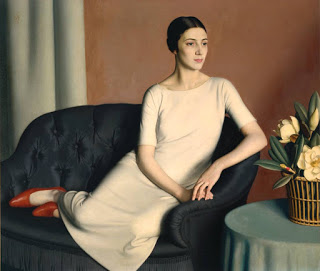
Marguerite Kelsey by Meredith Frampton, 1928, Tate, London.

Meredith Frampton was the son of a sculptor who created very detailed and finely finished paintings of a very modern style for the early 20th century. Some of his work, even veers toward the surreal in style. Frampton used a model for this work and dressed her in the latest austere fashions from Paris, making the work all the more modern in tone.

Herculaneum - The Redheaded Step Child

Pompeii A.D. 79 by Alfred Elmore, 1878, Yale Center for British Art

An exhibition entitled The Last Days of Pompeii: Decadence, Apocalypse, Resurrection opened on February 24th and runs through July 7, 2013 at the Cleveland Museum of Art. The exhibition features works inspired by the loss of the cities in 79 AD and their re-discovery in the early 18th century. It includes works by a wise range of artists from Piranesi and his detailed drawings of the site, to Rothko's abstract expressionist take on the murals from the Villa of the Mysteries.


Western Art


This weekend a new art venue opens on Cleveland's near west side. The Transformer Station is a project of the Fred and Laura Ruth Bidwell Foundation and a collaboration with The Cleveland Museum of Art that strives to being contemporary art to Cleveland's oft neglected west side. The opening exhibition is called Bridging Cleveland Photographs by Vaughn Wascovich also, Light of Day Photographs from the Collection of Fred and Laura Bidwell.

Happy Birthday, Ingres


Madame Moitessier, 1856 by Jacques-Auguste-Dominque Ingres, National Gallery of Art, London.

True to the fashion of his time, Ingres was more interested in painting historic scenes than doing portraits, but also true, portraits are an artist's bread and butter. Mme. Moitessier's husband asked Ingres to paint his wife's portrait and Ingres refused, upon meeting her however, he was intrigued and agreed to paint her. Notice how the use of the mirror behind her, gives us two portraits in one.

Happy Birthday Gustave

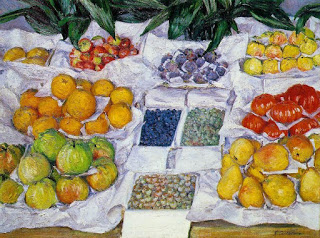
Fruit Displayed on a Stand by Gustave Caillebotte, 1881-2, Museum of Fine Arts, Boston.
Caillebotte existed on the fringes of the Impressionist group, as he was both a benefactor and a member of the group. He was a painter himself, but lived as a lawyer, solider, and engineer. He did not adhere closely to the painting by light and loose brush strokes of the Impressionists and his work belies his realistic-style training, however, he allowed enough of the looser, less studied style of the Impressionists to enter his work, that it was given a lightness, that more realistic work lacks.

Even in death he supported the Impressionists, leaving his vast collection to the French Government on the condition that it be displayed, not stored away. The artists and their work had not yet been embraced by the French people, and the government and they rejected that condition, but ended up accepting a portion of the work which they did display, making it the first time the artists of the group were displayed in a government exhibition.