Happy Birthday Gustave

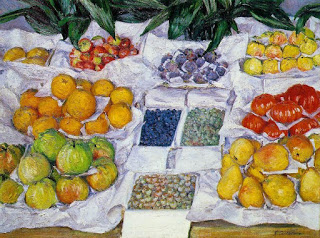
Fruit Displayed on a Stand by Gustave Caillebotte, 1881-2, Museum of Fine Arts, Boston.
Caillebotte existed on the fringes of the Impressionist group, as he was both a benefactor and a member of the group. He was a painter himself, but lived as a lawyer, solider, and engineer. He did not adhere closely to the painting by light and loose brush strokes of the Impressionists and his work belies his realistic-style training, however, he allowed enough of the looser, less studied style of the Impressionists to enter his work, that it was given a lightness, that more realistic work lacks.

Even in death he supported the Impressionists, leaving his vast collection to the French Government on the condition that it be displayed, not stored away. The artists and their work had not yet been embraced by the French people, and the government and they rejected that condition, but ended up accepting a portion of the work which they did display, making it the first time the artists of the group were displayed in a government exhibition.

Beautifully New

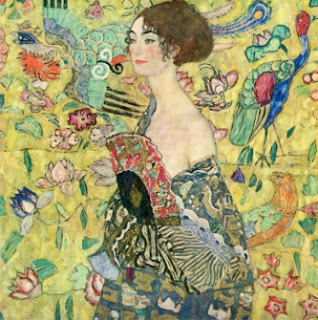
Lady with Fan by Gustav Klimt, 1917, Private Collection.

Happy Birthday to Gustav Klimt, today would have been his 150th birthday. The Austrian Art Nouveau painter, often chose women as his subjects and also used gold leaf to further embellish and decorate his work. There is a retrospective of his artwork at the Belvedere Museum in Vienna, Austria now through January 6, 2013.

Beautiful Perfection

Cupid and Psyche as Children by William-Adolphe Bouguereau, 1889, Private Collection.

Among the most popular and prolific artists of the 19th century, Bouguereau was a traditional academic-style painter as many other artists were shunning (or being shunned by) the French Art Academy and heading in different directions. He preferred classical subjects, such as Greek Mythology, and a very straight-forward, realistic, presentation. His work remains quite popular for it's beauty, and the obvious skill of the artist.

Directing the New Age

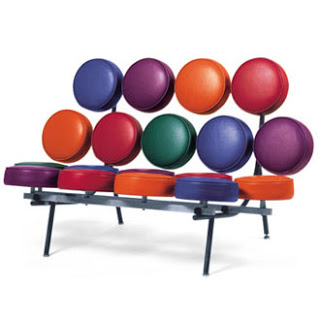
The Marshmallow Sofa by George Nelson and Irving Harper for Herman Miller, 1956.

George Nelson was offered the Directorship of The Herman Miller Furniture Company in 1945 following the publication of a book called, Tomorrow's House which he co-authored with Henry Wright. Under Nelson's leadership, mid-20th century design had a home and was allowed to flourish.

The Cranbrook Art Museum in Bloomfield Hills, MI is hosting a retrospective of Nelson's career through October 14, 2012.

Nurturing Young Talent

 Koala by Hannah Kiraly, 2012

Hannah Kiraly is my neighbor and a senior at Lakewood High School next year. Not long after I first met her I saw some of her photos and was blown-away by her natural talent. I have been pleased to see it grow and mature, as she as, and I believe it is important that she continue to take photos. Please check-out her work at the link on her name below, and just get a small glimpse of what she is up to. She is also a first rate cat sitter.

Hannah Kiraly: Click "Collect Me" to help me win a New York City photo exhibition and a$25,000 cash grant: One Life Photography Competition

Another View of the Jersey Shore

Jersey Shore by Mabel Hewit, c. 1935, Mary Ryan Gallery.

Mabel Hewit was from the Cleveland area and created woodblock prints in the "white-line" technique. Most of her subjects were everyday people and scenes. She enjoyed creating these prints, in part, because she felt that the brightly-colored woodblock prints were mare accessible to working people who were looking for colorful art for their homes.

Small Work on a Large Scale

Continuous Mile (Black) by Liza Lou, 2006-08, The Cleveland Museum of Art

Liza Lou is known for creating artwork out of beads and also for creating ambitious pieces. This work is a mile long length of beaded cotton rope that is then coiled around itself so that it forms a circle. It is created in a South African beading technique used by the Zulu peoples. Lou lives and works in both South Africa and Los Angeles.

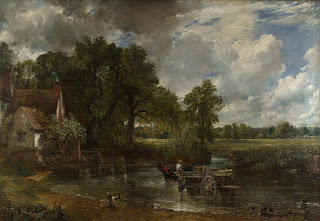
Happy Birthday John Constable


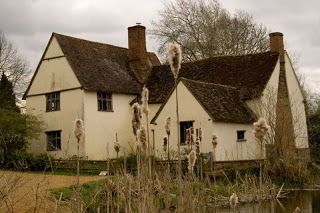
One of the most important British painters of the 19th century, Constable believed in painting out of doors in order to capture the most true, and realistic atmospheres, for his paintings. He did studies of nothing but clouds, so that he could render them perfectly. This is his most famous work featuring a hay cart, or hay wain, being ferried across the River Stour. The house in the background still exists and is in the care of the National Trust.
Constable was born today in 1776.


A Jewel Within a Jewel

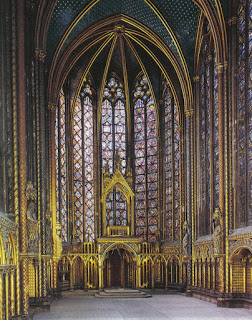
Sainte-Chapelle, 1242-48, Paris, Ile-de-France 

Built by King Louis IX as a Royal Chapel, this piece of Gothic architecture has been likened to an larger-than-life jewel in its own box. King Louis purchased a highly sought after relic, the crown of thorns purportedly worn by Jesus and wanted the finest reliquary he could get so he had this chapel built with 6,458 square feet of stained glass windows.

Honoring Power

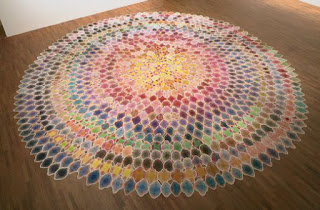
Blossom by Polly Apfelbaum, 2000, MoMA, NYC.

This piece is part of a series of installations Apfelbaum did that were named for, and dedicated to The Powerpuff Girls characters from the animated series. Apfelbaum liked the juxtaposition of the young girl characters possessed of super powers and fighting for good. The artist created each "petal" separately and then installed them piece by piece.

Second Glance


NATURE MORT AUX GRENADES by Mona Hatoum, 2006–07, Galleria Continua.

Palestinian in background and raised in Beirut, the art of Mona Hartoum reflects what she knows and what she has lived with. She studied art in London and found herself separated from her parents while she was there, and her art reflects the struggles she and her family have felt. This piece looks like a table covered in glass paperweights, but upon closer inspection you can see that they are brightly colored, glass replicas of hand grenades.


Site Specific

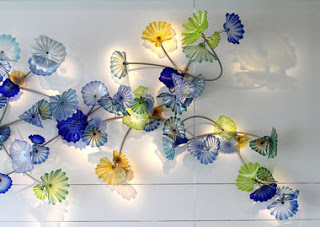
Ahuja Azure, Cirtron and Amber Persian Wall by Dale Chihuly, 2010, The University Hospitals' 

 Dale Chihuly is the most famous glass artist in the world. Since the later part of the 20th century, his installations have been gaining in popularity and recognition. Chihuly himself no longer blows the glass in his pieces, but he conceives and designs them and oversees their installation. The Dallas Arboretum is hosting an exhibition now through November 5, 2012.

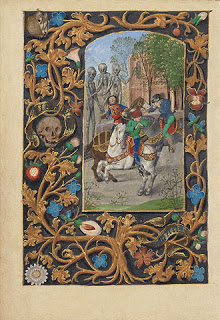
Beautiful Death


The Getty Museum is hosting an exhibition whose subject is the representation of death in medieval manuscripts. The manuscript was the most important piece of individually owned art during that time. People would commission artists, usually monks, to create books of prayers for them that were intended for personal use. They were small in size so the owner could easily carry them around. The exhibition entitled Heaven, Hell, and Dying Well: Images of Death in the Middle Ages runs through August 12, 2012.

The Road Less Travelled


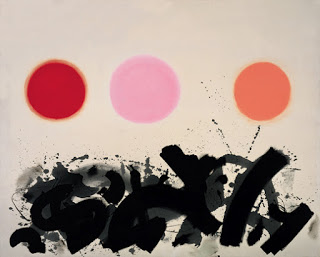
Adolph Gottlieb was one of the founders of the Abstract Expressionist movement. His work went from figural portraits in the 20's and 30's, to large amalgamations of images that resemble collages in the 40's, to stark divided canvases in the 50's and 60's. These later works are the ones he is best known for, the ones that require the viewer to study the painting and think about what is not represented, as Gottlieb himself put it,"...the very nature of abstract thought is to reduce the complexity of all of life and to bring it down to something very simple which embodies all this complexity"(from an interview of Gottlieb by Martin Friedman, 1962).

That is part of the challenge of Abstract Expressionism, it begs the viewer to invest in the work with their own thoughts and interpretations, and for this reason, many people are put-off by it. Some people would rather have the art do the work and entertain them, or clearly reflect the skill of the artist, and therefore abstract works, which seek to say a lot with very little, leave them wanting more.

Apaquogue is named for a road in East Hampton where the artist had a home.

Bringing the Modern to Tradition

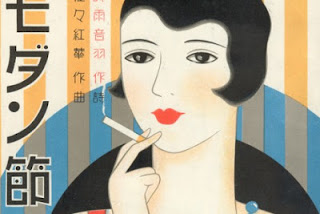
The Modern Song

(Modan bushi

) by

K. Kotani,

1930. (Detail.)

The Japan Society

(Credit: Exhibition organized and circulated by Art Services International, Alexandria, Va.)

The Japan Society

is currently hosting an exhibition of Japanese art from the

Art Deco

period. The work presented shows us a country working to combine tradition with the modern western world whose influence had been felt in Japan for a while, but whose culture was only then beginning to be adapted. This can be seen most prominently in the depiction of the Japanese version of the

"Flapper,"

or modern early 20th century woman, who was up-ending society in the west, as well.

The exhibition runs through June 10th at the

Japan Society, NYC

.

Hidden Meanings

The Ambassadors by Hans Holbein the Younger, 1533, The National Gallery, London.

Hans Holbein the Younger was born in Germany but spent most of his career in England as the court painter to Henry VIII. His work was strongly influenced by the Northern Renaissance painters like Jan van Eyck and Rogier van der Wyden. Their realistic style rendered in bright jewel tones, was his style, as well. This portrait of two men thought to be ambassadors to the English court from France, is filled with hints and puzzles about the men's lives, and even a message for we viewers. On the bottom of the piece in the center, you see a skull painted in Anamorphic perspective. It is seen only from particular angles and is thought be placed there to remind us all of our mortality.