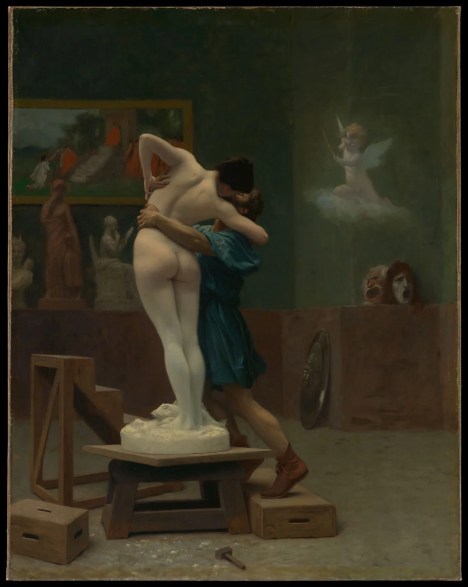
Pygmalion and Galatea by Jean-Leon Gerome, ca. 1890.
Gerome is well known for his beautiful paintings but he also took up sculpture late in his career and created a sculpture based on this same subject.
Pygmalion and Galatea by Jean-Leon Gerome, ca. 1890.
Gerome is well known for his beautiful paintings but he also took up sculpture late in his career and created a sculpture based on this same subject.
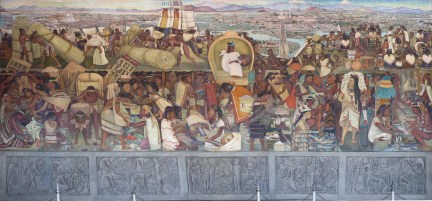
Colonisation: The Great City of Tenochtitlan by Diego Rivera, 1945, Mural from the National Palace, Mexico City.
Diego Rivera was an active and outspoken Communist who painted these murals (featuring the world of the Aztec people) after the Mexican Revolution as a way to give the Mexican people a sense of identity and pride in their history.
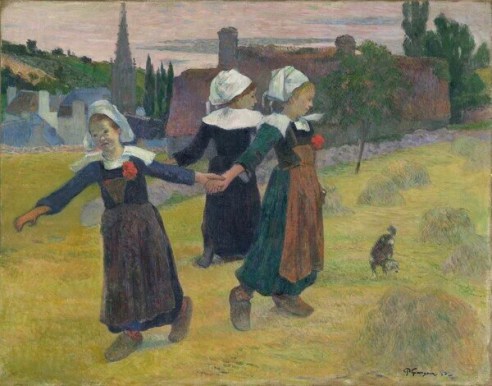
Breton Girls Dancing, Pont-Aven by Paul Gauguin, 1888, National Gallery of Art.
Known as the Volpini Suite, Gauguin’s ground-breaking show that is widely considered to be the first exhibition of Symbolist Art.
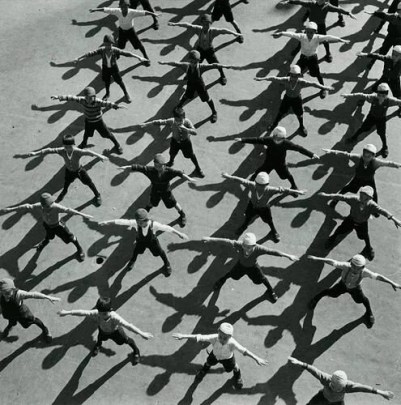
Rebel in the Making: Schoolboys Exercising, with One Eating an Apple (Japan, 1936), Fritz Henle,
I saw a wonderful show of the photography of Fritz Henle at that Ransom Center at the University of Texas, Austin in 2009. Henle was a master of many different types of photography. There is an excellent catalog of the exhibition published by the University of Texas Press called Fritz Henle In Search of Beauty.
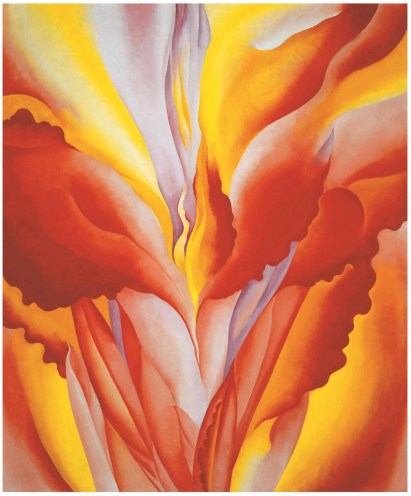
Red Canna by Georgia O’Keeffe, 1923, University of Arizonia Art Museum.
Everyone has many associations with a flower – the idea of flowers. Still-in a way – nobody sees a flower – really – it is so small – we haven’ t the time…So I said to myself – I’ll paint what I see – what the flower looks like to me but I’ll paint it big and they will be surprised into taking time to look at it. – Georgia O’Keeffe,
Georgia O’Keeffe, Viking, 1973.
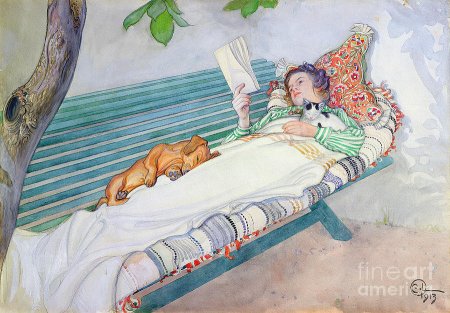
Woman Lying on a Bench by Carl Larsson, 1913, Louvre
I guess it is pretty obvious what I would like to be doing….
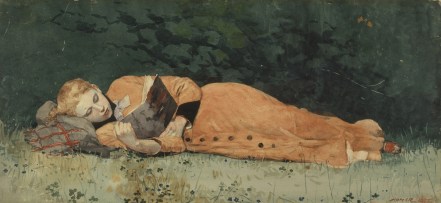
The New Novel by Winslow Homer, 1877, Museum of Fine Art, Springfield MA
This work is a favorite among avid readers and book clubs for obvious reasons. The orange of the dress and the girl’s hair provide a warm contrast against the background dominated by shades of brown and green.
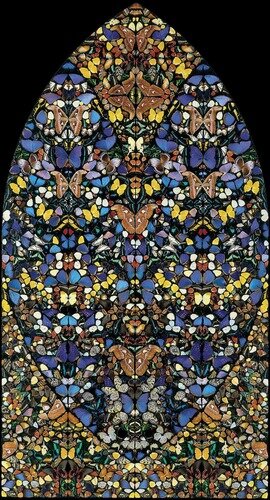
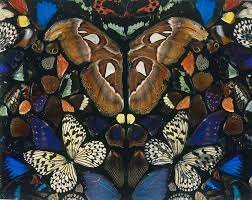
Prosperity – The Holy Place by Damien Hirst, 2006.
This work is created out of butterflies and the perfect symmetry of the insects is mirrored in the perfect symmetry of the work. At first glance it appears to be a stained glass window.
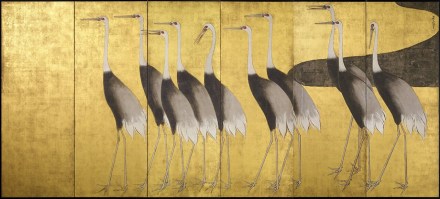
Cranes (detail) by Ogata Korin, Edo Period c. 1700, Freer Gallery of Art, Smithsonian
This is part of a larger work (a screen). The repetition of the from of the group of Cranes gives the work a lighthearted charm.